
Lamar County Court Records After Arrest
After a Lamar County jail arrest, the first public trail is often the booking entry at Lamar County Jail. That record is created by the jail after an arresting agency brings the person to Purvis for intake. The booking side can show the arresting agency, booking date, preliminary charge text, bond fields, warrant numbers, and release status when the public roster loads. The court record begins on a different track. It appears when a court receives a complaint, information, indictment, citation, warrant return, bond order, or other case filing tied to that arrest.
The local pathway involves several offices. Lamar County jail inmate records are the better source for current custody, recent booking facts, and roster fields. Court records after a jail arrest are handled through the clerk and court system. Lamar County Justice Court handles misdemeanors, initial appearances, preliminary hearings, felony bond hearings, and search warrants. County Court judges may set bond and preside over preliminary hearings. Felony cases that move forward are prosecuted by the 15th Circuit Court District Attorney, and the Circuit Clerk maintains criminal case records and related fines, costs, and restitution activity.
Important: A booking charge is an arrest-stage entry. A filed charge is the court allegation the prosecutor or court moves forward.
Search Lamar County Court Records
The statewide court-search channel for many Mississippi trial-court records is Mississippi Electronic Courts. Access can depend on registration, court participation, and document-access rules, so the portal should be paired with the Lamar County Circuit Clerk or the correct lower court when a search does not show what the reader expects. A jail roster entry may list a case number, court date, court type, or warrant number. Those fields are useful search clues, but they do not prove that every listed booking charge became a filed court charge.
The Mississippi Electronic Courts access portal is the source shown in the image below.
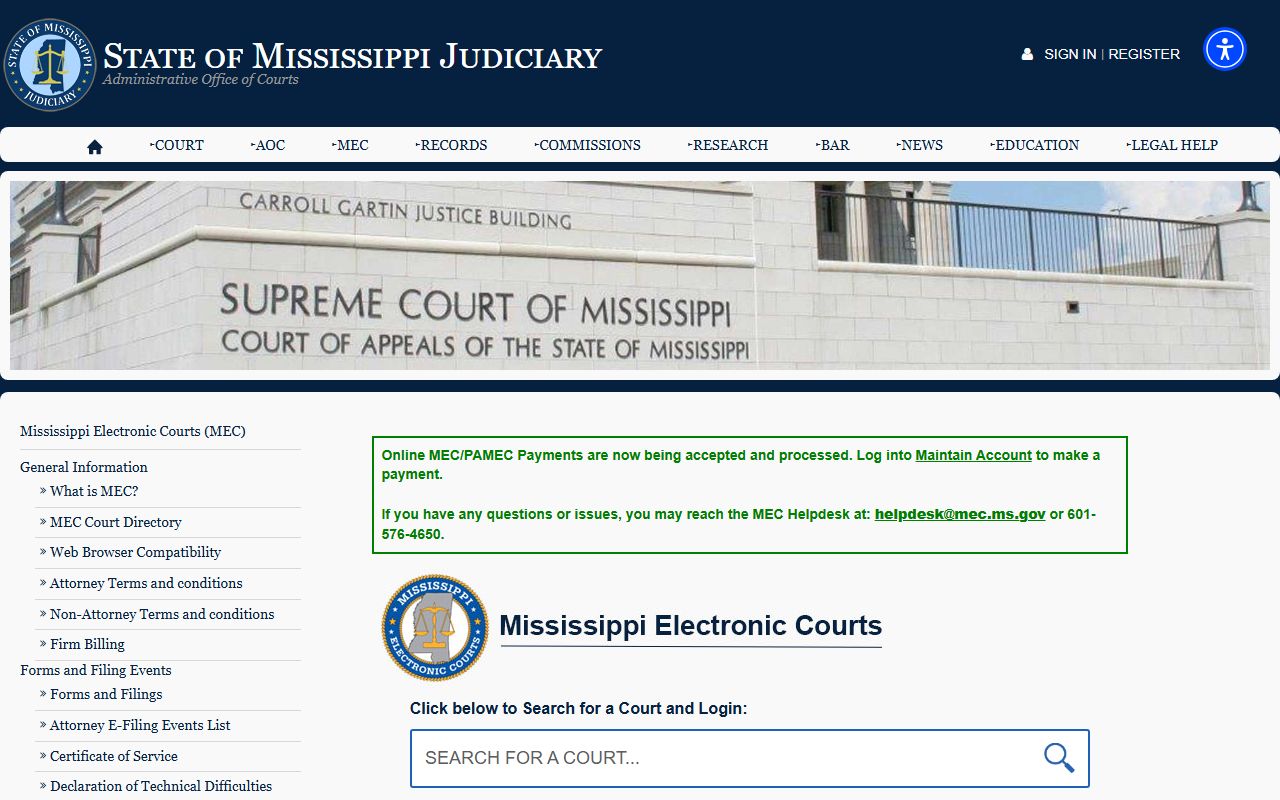
MEC is most useful after a case number, party name, court level, or county filter is known. When an arrest is very recent, the court filing may lag behind the booking entry.
| Field Label | Type | Required | Options / Format Notes |
|---|---|---|---|
| MEC login/search | Account portal | Varies | Mississippi Electronic Courts is the statewide trial-court e-filing and case system. Registration or paid access may apply for some document access. |
| Defendant name | Text | Typical | Search by last name and first name where party-name search is available. |
| Case number | Text | Typical | Use the case number from the roster, bond paperwork, indictment, citation, clerk notice, or court paperwork. |
| Court/county | Dropdown/filter | Typical | Select Lamar County and the court level when the portal requires a county or court filter. |
For felony case filings, indictments, criminal felony case numbers, dockets, and dispositions, the Circuit Clerk is the local records office. For initial appearances, misdemeanor pleas, misdemeanor trials, preliminary hearings, and felony bond hearings, Justice Court or County Court may be the better first contact. The 15th District Attorney can give prosecutor-office context for felony matters and victim services, but routine jail custody, bond payment, and roster questions should stay with the jail or court.
Lamar County Court Records Pathway
The practical flow is: arrest or warrant service, booking at Lamar County Jail, first appearance or bond review, charging review, court filing, hearings, and disposition. Lamar County Justice Court is a key early-stage court because its criminal division handles misdemeanors, preliminary hearings, initial appearances, and felony bond hearings. County Court judges may also issue search warrants, set bond, and preside over preliminary hearings. That is why a person may have jail data before a full Circuit Court case appears.
- Start with the roster or jail phone line for booking charges, bond, release status, and any warrant or court-date fields.
- Decide whether the matter looks like misdemeanor, traffic, contempt, initial appearance, preliminary hearing, or felony prosecution.
- Use Justice Court for misdemeanor pleas, misdemeanor trials, initial appearances, preliminary hearing context, and felony bond-hearing information.
- Use the Circuit Clerk or MEC for felony filings, indictments, court case numbers, dockets, and final dispositions.
- Use the 15th District Attorney only for felony prosecution context, victim services, bad-check matters, pretrial diversion, or case-process questions within that office's role.
Booking charges may use arresting-agency wording, officer-entered labels, or warrant text. Filed charges may be narrower, broader, reduced, amended, dismissed, or later replaced by an indictment. That difference matters when comparing a jail arrest to court records. A person can be booked on one set of allegations while the prosecutor files a different formal charge after review.
Lamar County Court Charging Records
Charging records explain how an allegation becomes a court case. A complaint is often used near the start of a misdemeanor, traffic, or early probable-cause matter. An information is a prosecutor-filed charging paper used when the law and case posture allow it. An indictment is returned by a grand jury and is common in more serious felony matters that move into Circuit Court. The exact document controls the filed charge, not the short label on a jail roster.
| Charging Document | Who Creates It | Common Lamar County Use | What to Check |
|---|---|---|---|
| Complaint | Officer, prosecutor, or court process depending on case type | Misdemeanors, traffic, early criminal filings, initial appearance context | Defendant name, sworn allegation, charge text, court date, and any bond order tied to the filing. |
| Information | Prosecutor | Formal prosecution when an information is permitted and used instead of an indictment | Charge level, statutory text, counts, plea history, and whether the defendant waived indictment when required. |
| Indictment | Grand jury | Serious felonies handled through Circuit Court and the 15th District Attorney | Count number, felony level, arraignment date, amended counts, and final disposition for each count. |
The local Circuit Clerk page states that the office establishes, maintains, and keeps court records and the official court seal. Its criminal division handles criminal work plus fines, costs, and restitution collection. Lamar County criminal case labels in the research include Criminal Felony, Criminal Misdemeanor, DUI, Traffic, Juvenile Abuse, Juvenile Delinquency, Juvenile, and Criminal Contempt. Juvenile labels do not mean juvenile files are open to the same degree as adult criminal records.
The Lamar County Circuit Clerk criminal records page is reflected in the source image below.
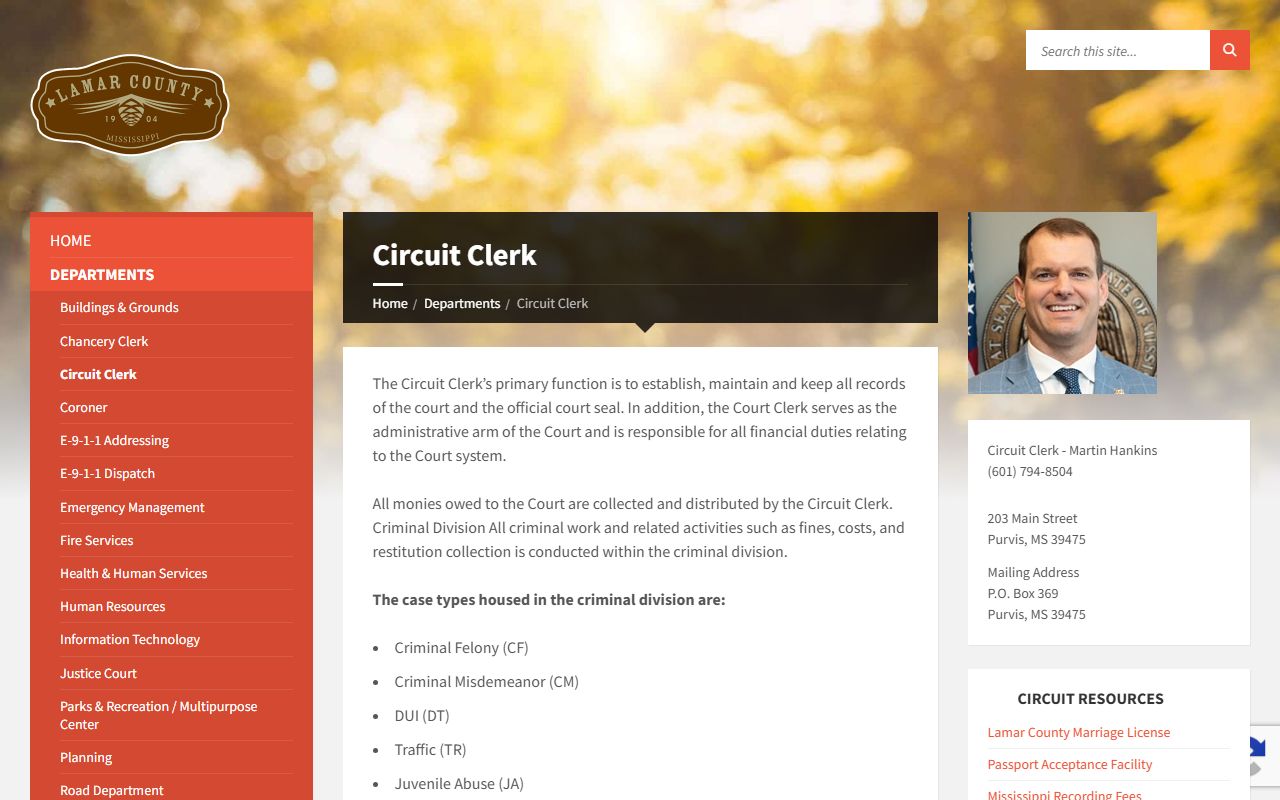
The clerk route is strongest when a filed case number, indictment, disposition, fine, cost, or restitution question is involved.
Lamar County Court Charge Status
Charge status is the bridge between a booking and a court outcome. A charge can start as pending, move through bond and hearing dates, then become amended, reduced, dismissed, nolle prosequi, pleaded, tried, or sentenced. The phrase nolle prosequi means the prosecutor has chosen not to proceed on that charge at that time. A dismissal is a court action ending that charge. Neither phrase should be read as the same thing as expunction.
| Status | What It Means | Where It May Appear |
|---|---|---|
| Pending | The charge has not reached a final court outcome. | Roster fields, clerk docket, MEC case screen, or hearing notice. |
| Amended | The filed charge or count changed after review, plea talks, indictment, or court order. | Clerk docket, prosecutor filing, amended information, amended indictment, or court order. |
| Reduced | The charge moved to a lesser offense or lower level. | Plea order, amended charge, disposition entry, or sentencing record. |
| Dismissed | The court ended the charge without a conviction on that count. | Disposition entry, order of dismissal, or docket notation. |
| Nolle prosequi | The prosecutor elected not to proceed with the charge. | DA filing, docket entry, or final charge disposition. |
| Convicted | The case ended in a guilty plea, verdict, or other conviction entry. | Disposition, sentencing order, clerk record, and sometimes state criminal-history records. |
Mississippi public-records law gives broad access to public records, but law-enforcement investigative material can be exempt. Court records after a jail arrest are often more stable than an arrest roster entry because they reflect filed actions and judicial orders. Still, docket entries can be delayed, and some documents may require clerk contact rather than a free web search.
Lamar County Court Bond Records
Bond is part of the court pathway after a jail arrest, not just a jail payment issue. The sheriff's jail text says a person turned over to Lamar County Jail may be allowed to post bond and be released pending a court hearing, or may be held until the courts dispose of the case. Justice Court handles initial appearances and felony bond hearings. County Court judges may also set bond and preside over preliminary hearings. A preliminary hearing is an early hearing used in felony matters to test probable cause before the case moves further.
| Bond Type | How It Works | What to Confirm |
|---|---|---|
| Cash bond | Cash is posted according to the bond amount and court or jail instructions. | Current amount, payment location, receipt rules, and whether all holds clear. |
| Surety bond | A licensed bail agent posts a bond for a fee under Mississippi bond rules. | Whether the charge allows surety bond and whether a court has added conditions. |
| Personal recognizance | The court releases the person on a promise to appear and follow conditions. | Next court date, reporting rules, travel limits, and no-contact terms if ordered. |
| Property bond | Property secures release when accepted by the court. | Eligibility, paperwork, valuation, and where the bond must be approved. |
| No-bond hold | Release is blocked because no bond is set or another legal hold prevents release. | Whether the block is from Lamar County, MDOC, another county, federal custody, or ICE. |
No official Lamar County active-warrant search page was located in the research. Warrant questions therefore use a fallback chain: the Lamar County Sheriff's Office for warrant/process questions, the jail if a warrant already caused a booking, Justice Court for misdemeanor, traffic, criminal contempt, initial appearance, preliminary hearing, and search-warrant context, and Circuit Clerk or MEC when the warrant is tied to a filed court case. Third-party warrant lists should not be treated as official proof.
The Lamar County Justice Court page documents the court's bond-hearing and preliminary-hearing role shown here.
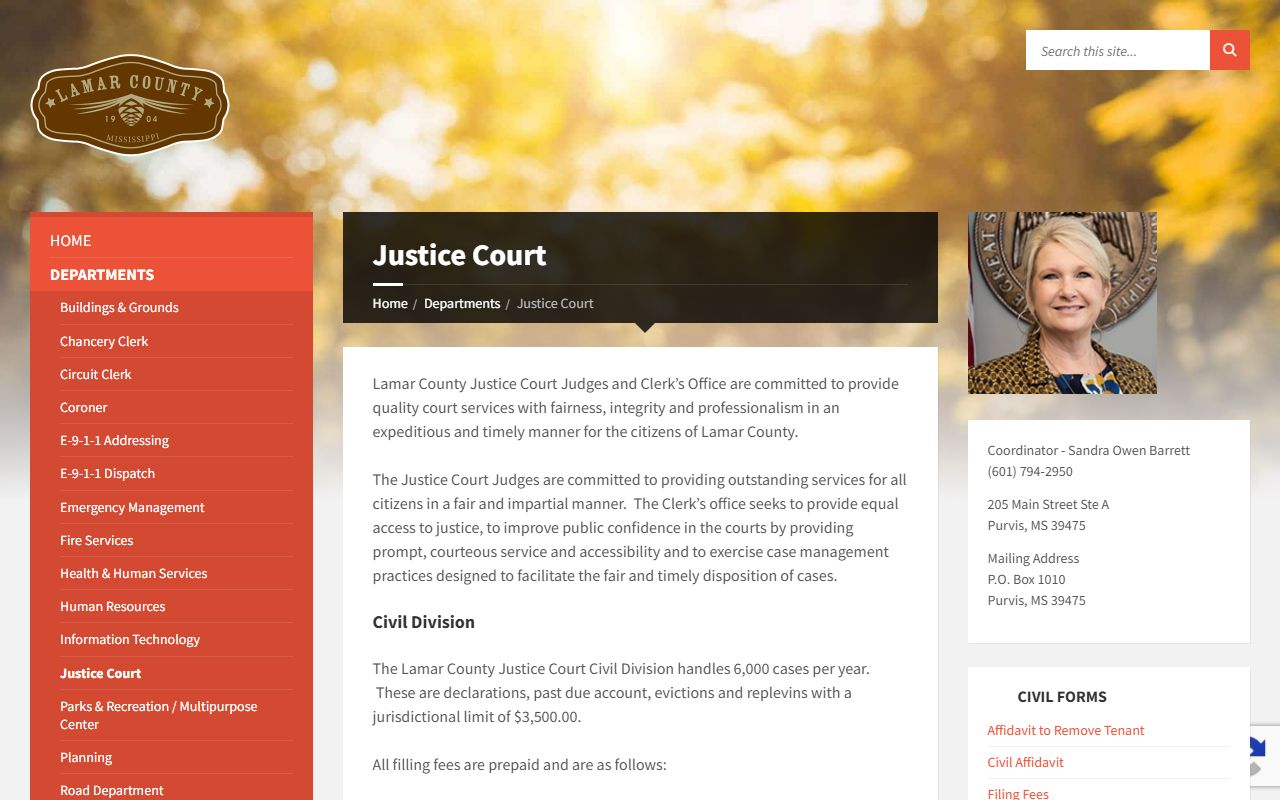
Justice Court is often the practical first court contact when the arrest is new and the question involves bond, initial appearance, misdemeanor court, or a preliminary hearing.
Lamar County Felony Prosecution Records
The 15th Circuit Court District Attorney serves Jefferson Davis, Lamar, Lawrence, Marion, and Pearl River Counties. The research identifies Hal Kittrell as District Attorney. The office focuses on felony prosecution, victim services, law-enforcement advice, bad checks and economic crime, pretrial diversion for first-time nonviolent offenders, and public education. It prosecutes serious felony crimes such as murder, robbery, rape, child molestation, drugs, burglary, and other crimes that can lead to state prison time.
That role matters because a Lamar County arrest for a serious felony may not end with the same charge label seen at booking. The prosecutor may review reports, speak with law enforcement, present the case to a grand jury, file or amend charges, offer diversion when eligible, dismiss a charge, or proceed toward plea or trial. The DA does not normally prosecute misdemeanors handled in municipal or justice court, and the DA should not be used for routine custody, mugshot, roster, or bond-payment questions.
Lamar County Court Charge vs Conviction
A court records search after a jail arrest must separate accusation from outcome. A charge means the government alleges an offense. A conviction means the case ended with a guilty plea, guilty verdict, or other conviction entry. Arrest, charge, conviction, and sentence are different points in the same path. They should not be merged in background notes, job decisions, tenant screening, or public summaries.
| Point of Comparison | Charge | Conviction |
|---|---|---|
| Stage | Accusation after arrest, complaint, information, indictment, citation, or warrant. | Final guilt finding, plea, or conviction entry on a charge. |
| Proof Level | May begin with probable cause or a charging decision. | Requires proof beyond a reasonable doubt or a valid guilty plea. |
| Record Meaning | Shows what was alleged or filed. | Shows the person was found or admitted guilty on that count. |
| Can Change? | Yes. Charges may be amended, reduced, dismissed, or replaced by indictment. | Yes, but only through appeal, post-conviction relief, expunction eligibility, or other lawful process. |
For booking photos tied to current custody, use the dedicated Lamar County jail mugshots material rather than treating a court docket as a photo source. Court records focus on charges, hearings, orders, and outcomes.
Lamar County Sealed Court Records
Mississippi's Public Records Act starts from a public-access rule, but other laws create limits. Investigatory records can be withheld when a law-enforcement exemption applies. Juvenile matters, sealed cases, expunged records, medical details, security-sensitive jail records, and active investigations may not be available through a public search. A dismissed charge can still appear in records until a court order or agency process changes how the record is held or shown.
| Point of Comparison | Sealed | Expunged |
|---|---|---|
| Public Visibility | Hidden from general public view, with access limited by court rule or order. | Removed from public access or treated under the expunction order as allowed by law. |
| Agency Access | Some courts or justice agencies may still see the record for allowed purposes. | Access depends on the statute, order, and agency duty tied to the record. |
| Best Source | The court order sealing the case and the clerk handling that file. | The expunction order and agencies named or affected by the order. |
| Lamar County Step | Ask the clerk which record is sealed and what public access remains. | Use the court order with the clerk, sheriff, jail, and any state repository that holds the affected record. |
Mississippi Code Section 99-19-71 is the key expunction statute identified in the research. Eligibility is fact-specific. Dismissal, acquittal, nonadjudication, diversion, misdemeanor history, felony type, and waiting periods can all matter. A person seeking expunction should use the court file and final disposition, not just the original arrest entry.
Lamar County Court Record Limits
Public case lookups, roster checks, and clerk searches are not the same as a regulated employment, tenant, credit, or insurance background check. Consumer reports are governed by the Fair Credit Reporting Act and must follow separate rules on permissible purpose, notice, accuracy, and dispute rights. Casual public-record review can help a reader understand a case path, but it should not be used as a substitute for an FCRA-compliant process when the use is covered by that law.
Important: Public court and jail lookups are not consumer reports and must not be used for FCRA-covered screening decisions.
For official copies, disposition proof, or a corrected public record, use the agency that holds the original file. In Lamar County that may mean the Circuit Clerk for felony court records, Justice Court for misdemeanor and preliminary-hearing records, the Sheriff's Office or jail for booking records, MDOC for sentenced state-prison records, or another state or federal office if the person left county custody.